Solutions

Real-Time Location System (RTLS)

Sub-meter indoor positioning for assets, equipment, and people. Know exactly where everything is — always. Zone alerts, workflow automation, and utilisation analytics.

<1m
Location Accuracy
Real-Time
Position Updates
30min
Daily Search Time Saved

The Problem

Knowing Which Zone Isn't Enough

Standard RFID tells you an asset is in a building or a zone. RTLS tells you its exact position — down to the metre — in real time. In large facilities, hospitals, and manufacturing plants, this precision difference is the difference between a 30-second find and a 30-minute search.
"Where is it?" Costs a Fortune
Studies show clinical staff spend 30+ minutes per shift searching for equipment. In hospitals alone, this costs millions annually in wasted time.
No Sub-Meter Indoor Accuracy
Standard RFID shows which zone an asset is in, but not exactly where within that zone. In large facilities, this gap still means significant search time.
Patient Safety Risks
In healthcare, not knowing the location of critical equipment — defibrillators, IV pumps, ventilators — is a patient safety crisis waiting to happen.
Industrial Process Delays
In manufacturing, not knowing where WIP or tools are causes production line stoppages that cascade into major schedule failures.
Security Blind Spots
Without precise location, security responses are delayed, trespassers are undetected, and incident investigations lack evidence.
Hospital interior with real-time location tracking anchors and live asset position map

The Solution

Sub-Metre Location Intelligence

Sub-Meter Accuracy

Locate assets and people within 0.3-1 metre accuracy using advanced RFID, UWB, or BLE triangulation.

Real-Time Asset Mapping

Live floor map shows the exact position of every tagged asset, updated multiple times per second.

Zone-Based Alerts

Configurable geofence alerts fire when assets or people enter/exit defined zones — without any manual checking.

Workflow Automation

Location events trigger automated actions — routing requests, equipment assignments, maintenance tickets.

Movement History

Complete historical tracking of every asset's movements — searchable, reportable, and available for process optimisation.

Utilisation Analytics

Time-in-zone, active-time, and movement frequency analytics identify underutilised assets and operational bottlenecks.

Implementation

How RTLS Works

1

Deploy Location Infrastructure

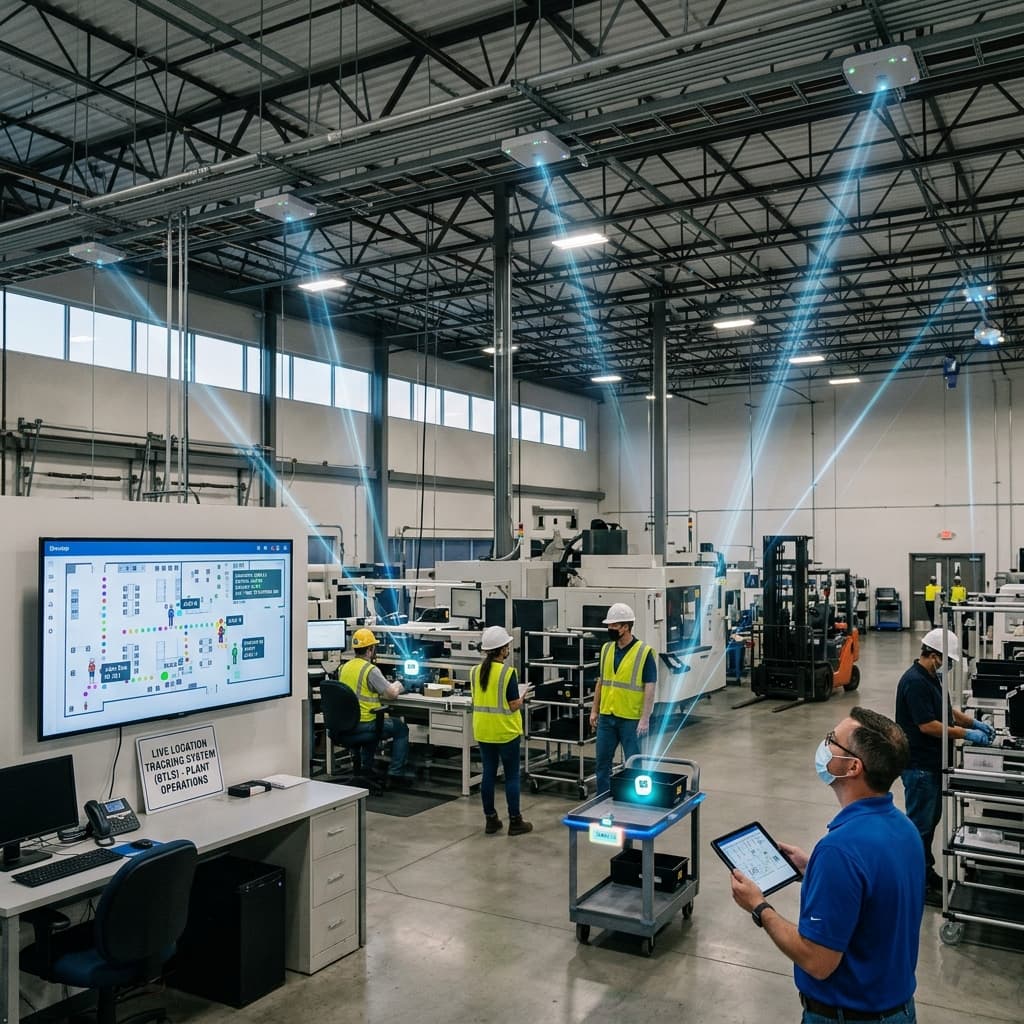
Reference readers (anchors) are installed at known positions throughout the facility, creating a spatial reference grid.

2

Tag Assets & People

Assets receive RFID/UWB tags. People carry badges or wearables. Tags emit signals that anchors use for triangulation.

3

Calculate Real-Time Positions

The RTLS engine triangulates each tag's position from multiple anchor readings, calculating location multiple times per second.

4

Visualise, Alert & Act

Live floor maps, zone alerts, workflow triggers, and analytics provide immediate operational intelligence and automated responses.

Who Uses This

Industries

HealthcareManufacturingAirportsOil & GasConstructionData Centres

Technology Options

RTLS Technologies

FAQ

Common Questions

What positioning technology does SomasRO's RTLS use?
We deploy the right technology for each use case: Passive UHF RFID for zone-level tracking (3-5m accuracy), Active RFID for room-level (1-2m), UWB for sub-metre precision, and BLE for cost-effective mid-range deployments. Many installations combine multiple technologies.
How does RTLS differ from standard RFID tracking?
Standard RFID tells you when an asset passed a fixed point (e.g., a doorway). RTLS gives you continuous, real-time position updates anywhere in the facility — not just at chokepoints.
Can RTLS work in multi-floor buildings?
Yes. We use floor-level anchors and z-axis calculation to track assets across multiple floors. The dashboard shows the current floor and X/Y position for every tagged asset.
How is RTLS used in hospitals?
Hospital RTLS tracks IV pumps, infusion pumps, wheelchairs, stretchers, defibrillators, and staff. Clinical staff can find equipment in seconds instead of minutes. It also supports infant protection, hand hygiene compliance, and staff duress alerting.
What size facility does RTLS work in?
RTLS scales from a single floor of a hospital to an entire industrial campus. The anchor density (anchors per square metre) is adjusted to achieve the required accuracy level across any facility size.

Ready to Know Exactly Where Everything Is?

Our RTLS specialists will conduct a site survey and recommend the right positioning technology for your accuracy and budget requirements.

Chat on WhatsApp