Solutions

Smart Warehousing with RFID & IoT

Transform your warehouse into an intelligent, self-optimizing operation. Combine RFID tracking, IoT sensors, and AI analytics for complete operational intelligence.

40%
Labour Cost Reduction
25%
Inventory Reduction
20%
Energy Savings

The Problem

Traditional Warehouses Are Running on Guesswork

Most warehouses today generate enormous amounts of data — but none of it is connected, real-time, or actionable. Decisions are made based on yesterday's reports, not today's reality. Smart warehousing changes the operating model from reactive to predictive.
Disconnected Systems
RFID, barcode, WMS, ERP, and IoT systems that don't communicate — creating data silos and operational blind spots.
Reactive Operations
Without predictive analytics, operations teams react to problems after they've already caused delays or losses.
High Operational Costs
Manually managed warehouses rely on excess labour, excessive safety stock, and inefficient energy consumption.
No Environmental Monitoring
Temperature-sensitive goods, humidity-dependent materials, and sensitive equipment suffer from unmonitored storage conditions.
Inability to Scale
Traditional warehouse systems cannot scale to handle growing SKU counts, order volumes, and multi-site complexity.
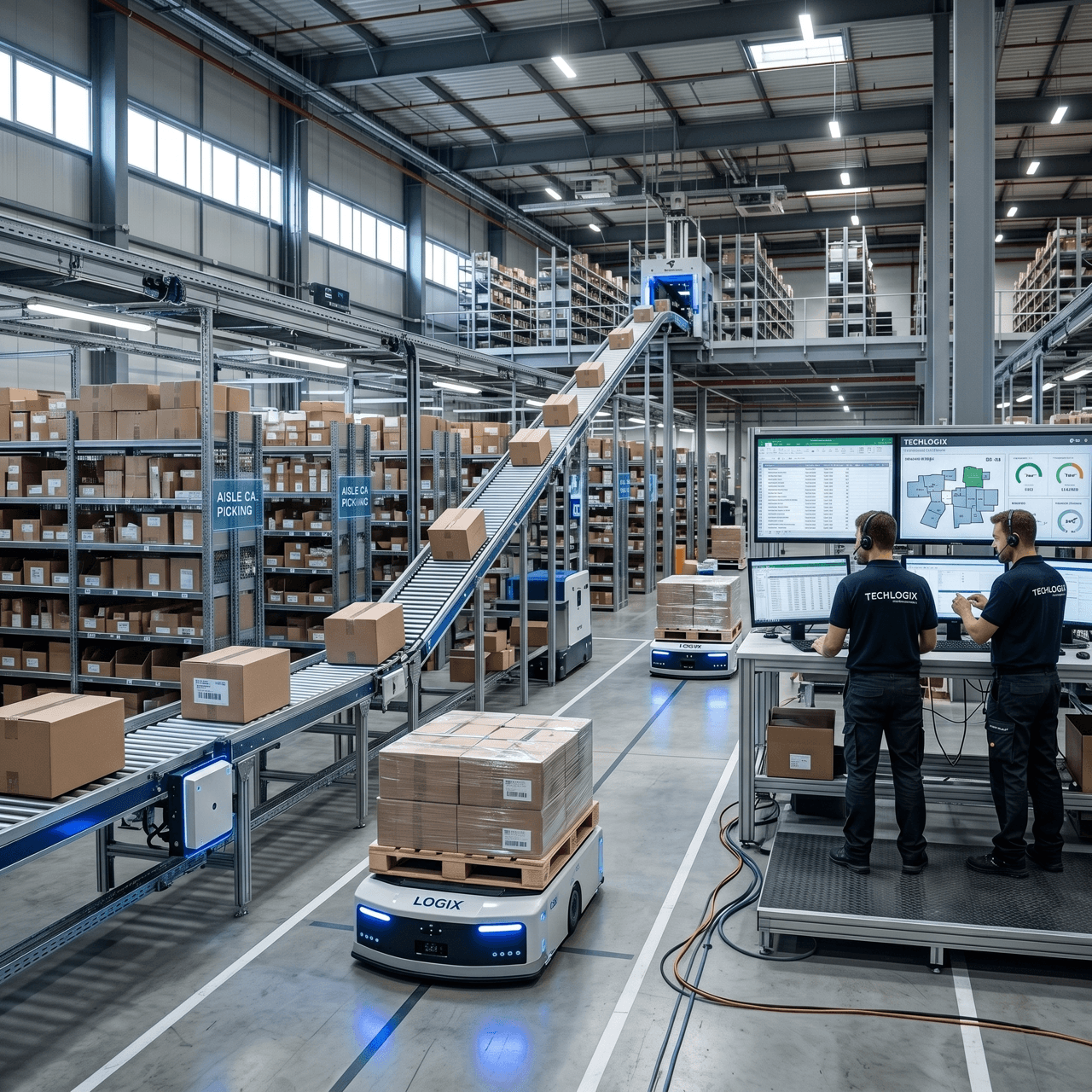
Futuristic smart warehouse with autonomous robots and IoT RFID sensors

The Solution

What Smart Warehousing Delivers

AI-Powered Analytics

Machine learning algorithms predict demand, optimize space allocation, and identify operational inefficiencies automatically.

IoT Sensor Integration

Temperature, humidity, motion, and door sensors integrate with RFID data for complete environmental and operational awareness.

Predictive Maintenance

Equipment sensors predict maintenance needs before breakdowns occur, eliminating unplanned downtime.

Automated Workflows

Rules-based automation triggers actions — reorder requests, zone alerts, task assignments — without human intervention.

Energy Optimization

Smart HVAC and lighting controls, triggered by occupancy sensors, reduce warehouse energy consumption by 20-30%.

Digital Twin

Real-time digital representation of your entire warehouse — inventory positions, equipment status, and environmental conditions.

Implementation

Four Layers of Intelligence

1

Deploy RFID Infrastructure

RFID readers, antennas, and tags provide the foundational layer of item-level and location-level data.

2

Layer IoT Sensors

Environmental sensors (temperature, humidity, vibration) and equipment sensors overlay operational intelligence on top of RFID data.

3

Connect All Systems

Our integration layer connects RFID, IoT, WMS, ERP, and energy management systems into a single data fabric.

4

Activate AI & Automation

The analytics engine learns from historical data to generate predictions, and the automation layer acts on those predictions in real time.

Who Uses This

Industries

Warehousing & LogisticsManufacturingRetailCold ChainPharmaceuticalsE-commerce

Technology Stack

Core Components

FAQ

Common Questions

What makes 'smart warehousing' different from standard RFID?
Standard RFID provides visibility — you know where things are. Smart warehousing adds intelligence — the system tells you what to do next, predicts what will happen, and automates responses. It's the difference between a thermometer and a thermostat.
What IoT sensors does the system support?
We support temperature/humidity sensors, door/access sensors, occupancy sensors, vibration/shock sensors, CO2 monitors, and industrial equipment health sensors. The platform has an open API for adding new sensor types.
Does smart warehousing require replacing our existing WMS?
No. Our platform sits alongside your existing WMS as an intelligence layer, enriching it with RFID and IoT data. We integrate with all major WMS platforms and can work with legacy systems via API connectors.
What ROI can we expect from smart warehousing?
Clients typically achieve: 30-40% labour cost reduction, 20-25% inventory reduction through better forecasting, 15-20% energy cost savings, and near-zero unplanned equipment downtime. ROI is typically 12-18 months.
How long does a smart warehousing implementation take?
Implementation is phased: RFID foundation (6-8 weeks) → IoT sensor deployment (2-3 weeks) → integration and analytics activation (3-4 weeks) → AI training period (4-6 weeks for models to learn patterns). Total: 15-21 weeks for full capability.

Ready to Build a Smarter Warehouse?

Talk to our smart warehousing specialists. We'll design an intelligent automation roadmap for your specific operations.

Chat on WhatsApp